The Social Security System pays a monthly pension for life to members who reach retirement age with at least 120 monthly contributions. The amount comes from three formulas, and SSS pays whichever is highest. Here is how each one works, with a worked example.
Who qualifies
- Optional retirement at age 60, if you are no longer working or paying contributions as self-employed.
- Technical retirement at age 65, whether or not you still work.
- At least 120 monthly contributions before the semester of retirement. With fewer, SSS pays a one-time lump sum of all contributions plus interest instead of a monthly pension. You can keep paying as a voluntary member to reach 120.
Two numbers you need
Average Monthly Salary Credit (AMSC). The higher of the average of your last 60 monthly salary credits, or the average of all your salary credits. The salary credit is the bracket your contribution was based on, not your exact salary.
Credited Years of Service (CYS). The number of calendar years in which you paid at least six monthly contributions. Twenty years of steady contributions is 20 CYS.
The three formulas
SSS computes the basic monthly pension three ways and pays the highest:
- ₱300 + 20% of AMSC + 2% of AMSC for each credited year beyond 10
- 40% of AMSC
- A minimum pension: ₱1,200 with at least 10 credited years, or ₱2,400 with at least 20
Formula 1 rewards long service; formula 2 helps members with few years but a high salary credit; formula 3 protects members with low salary credits.
Worked example
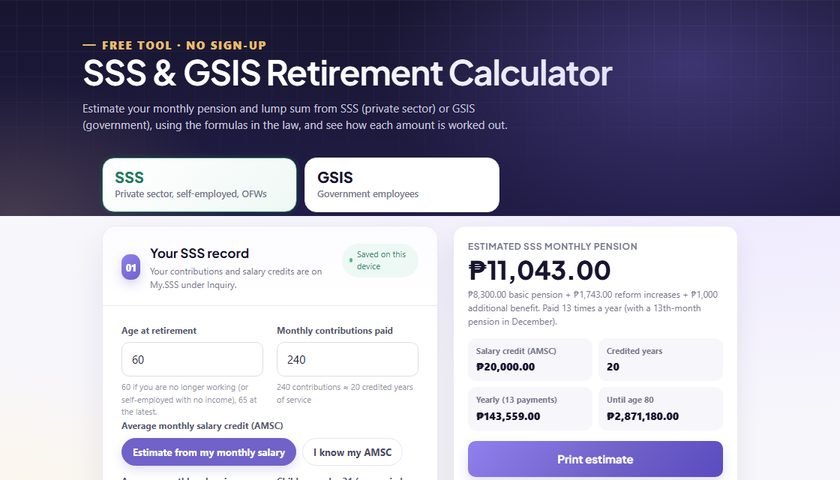
Ben retires at 60 with 240 monthly contributions (20 credited years) and an AMSC of ₱20,000.
| Formula 1: 300 + (20% × 20,000) + (2% × 20,000 × 10) | 300 + 4,000 + 4,000 = ₱8,300 |
| Formula 2: 40% × 20,000 | ₱8,000 |
| Formula 3: 20 or more credited years | ₱2,400 |
| Basic monthly pension (highest) | ₱8,300 |
| Plus the ₱1,000 additional benefit | ₱9,300 a month |
The pension is paid 13 times a year: a 13th-month pension is released every December.
Additions and options
- ₱1,000 additional benefit, added to every monthly pension since 2017.
- Dependents’ pension: for each minor child, up to five, 10% of the basic pension or ₱250, whichever is higher.
- Pension increases: SSS announced increases of 10% a year under its Pension Reform Program starting September 2025. The calculator on this site can include them as an estimate.
- 18-month advance: you may take the first 18 monthly pensions at once, discounted, and the monthly pension starts on the 19th month. The ₱1,000 additional benefit is still paid monthly.
How to raise your pension
Because formula 1 grows with both AMSC and years, two things help: paying contributions on your full salary (a higher salary credit), and having more calendar years with at least six contributions. Gaps of whole years without contributions lower the credited years. Members who are self-employed, OFWs or voluntary members choose their own salary credit, so paying on a higher bracket in the last five years can raise the AMSC.
If you are in government: GSIS
Government employees retire under GSIS, not SSS. Under RA 8291 you need at least 15 years of service and age 60. The basic monthly pension is the revalued average monthly compensation (the average monthly compensation plus ₱700) times 37.5%, plus 2.5% for each year of service beyond 15, up to 90%.
For example, with an average monthly compensation of ₱30,000 and 30 years of service: (30,000 + 700) × (37.5% + 15 × 2.5%) = 30,700 × 75% = ₱23,025 a month. Under Option 1 you receive 60 months of pension as a lump sum and the monthly pension starts after five years; under Option 2 you receive 18 months as cash and the monthly pension starts right away.
Run your own numbers
The SSS and GSIS retirement calculator applies all three SSS formulas, the dependents’ pension and the 18-month advance, and shows GSIS Option 1 and Option 2 side by side. Always confirm the final amount with SSS or GSIS before you file.