Overtime is not calculated the same way everywhere. Some countries count it by the week, some by the day, and some leave it to contracts. This guide compares the common rules and works through real examples so you can check a paycheck.
The basic method
- Add up the hours worked, leaving out unpaid meal breaks.
- Split them into regular hours and overtime hours using the rule that applies to you.
- Pay regular hours at the regular rate and overtime hours at the overtime rate, usually 1.5 times (“time and a half”).
Paid holidays, vacation and sick hours are paid but normally do not count as hours worked for overtime.
United States (federal FLSA)
Non-exempt employees earn 1.5 times the regular rate for hours over 40 in a workweek. Federal law has no daily overtime, so a 12-hour day is not overtime by itself if the week stays at 40 hours or less. The workweek is any fixed, recurring 168-hour period the employer chooses; weeks cannot be averaged.
Example: $20 an hour, 46 hours in the week. 40 × $20 = $800, plus 6 × $30 = $180, for $980.
Many salaried managers and professionals are exempt. Being paid a salary does not by itself make someone exempt: the job duties and a minimum salary level both count.
California
California adds daily rules on top of the weekly rule:
- 1.5 times for hours over 8 in a workday, and for hours over 40 in a workweek
- 2 times (double time) for hours over 12 in a workday
- On the seventh consecutive day of work in a workweek: 1.5 times for the first 8 hours and 2 times after 8
Example: $20 an hour. Monday 13 hours, Tuesday to Thursday 8 hours each. Monday is 8 regular, 4 overtime and 1 double time. The week is 32 regular hours ($640), 4 overtime hours at $30 ($120) and 1 double-time hour at $40 ($40): $800. Under the federal rule alone the same 37 hours would be $740.
Canada
Overtime is set by each province, and by the Canada Labour Code for federally regulated workplaces:
- Ontario: 1.5 times after 44 hours in a week.
- British Columbia: 1.5 times after 8 hours a day and after 40 hours a week; 2 times after 12 hours a day.
- Alberta: 1.5 times after 8 hours a day or 44 hours a week, whichever gives more overtime hours.
- Federal: 1.5 times after 8 hours a day and 40 hours a week.
United Kingdom
There is no legal right to an overtime premium in the UK. Overtime pay depends on the contract. Two legal limits still apply: average pay for all hours worked must not fall below the National Minimum Wage, and average working time is limited to 48 hours a week over 17 weeks unless the worker opts out in writing.
Australia
The National Employment Standards set a maximum of 38 ordinary hours a week plus reasonable additional hours. Overtime rates come from the applicable award or agreement. Many awards pay 1.5 times for the first two or three hours of overtime and double time after that, with higher rates on Sundays and public holidays.
Philippines
Under the Labor Code, work beyond 8 hours a day on an ordinary working day is paid at the hourly rate plus 25%. On a rest day or special day, the first 8 hours are paid at 130%, and overtime on those days adds another 30% of that rate. Work between 10 PM and 6 AM earns a night shift differential of at least 10%.
Example: a daily rate of ₱800 is ₱100 an hour. Two hours of overtime on an ordinary day pay 2 × ₱125 = ₱250.
Checking your paycheck
- Keep your own record of times in and out, including unpaid breaks.
- Know where your workweek starts. The same hours can give different overtime if the week is cut differently.
- Bonuses and shift premiums can raise the “regular rate” used for overtime in the United States.
- If something looks wrong, ask payroll first, then your labor department.
Do it automatically
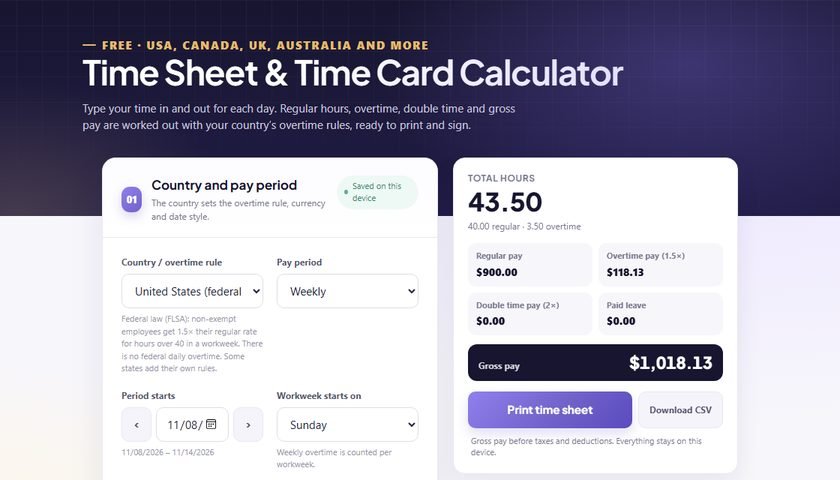
The time sheet and overtime calculator has these rules built in, including the California seventh-day rule and the Alberta “whichever is greater” rule, and prints a signed time sheet. This guide is general information, not legal advice.