Every December, rank-and-file employees in the Philippines receive their 13th month pay, and some also get a 14th month pay. This guide explains who is entitled, how the amount is computed, and when part of it becomes taxable.
What the law requires
Presidential Decree No. 851 requires employers in the private sector to pay a 13th month pay to all rank-and-file employees who have worked for at least one month during the calendar year, whatever their position, status or how they are paid. It must be paid on or before 24 December. Employers may pay half earlier, for example in June, and the rest before Christmas.
Managerial employees are not covered by the law, although many companies give them a 13th month pay by policy.
How to compute the 13th month pay
The 13th month pay is one-twelfth of the total basic salary earned during the calendar year.
- Basic salary is the pay for work done, after unpaid absences. It does not include overtime, holiday pay, night shift differential, allowances or cost-of-living allowances, unless the company has always included them.
- Paid leave counts as basic salary; unpaid leave and absences do not.
- An employee who resigns or is dismissed during the year receives the 13th month pay in proportion to the months worked.
| Situation | Computation | 13th month pay |
|---|---|---|
| ₱24,000 a month, full year, no unpaid absences | ₱288,000 ÷ 12 | ₱24,000.00 |
| ₱24,000 a month, hired 1 April | ₱216,000 (9 months) ÷ 12 | ₱18,000.00 |
| ₱24,000 a month, 5 days of unpaid leave (daily rate ₱1,103.45 on a 261-day factor) | (₱288,000 − ₱5,517.24) ÷ 12 | ₱23,540.23 |
Is the 14th month pay required?
No. No law requires a 14th month pay in the private sector. Employers give it through company policy, an employment contract or a collective bargaining agreement. Once it is given regularly over the years, it can become a company practice that cannot simply be withdrawn, so check your contract or HR policy.
There is no set formula. It is usually one month’s basic salary, often paid in the middle of the year.
In government
Government employees receive a mid-year bonus of one month’s basic salary in May and a year-end bonus of one month’s basic salary in November, plus a ₱5,000 cash gift. They may also receive a productivity enhancement incentive and a performance-based bonus. For tax purposes all of these are “other benefits”, just like the 13th month pay in the private sector.
The ₱90,000 tax-free ceiling
Under the TRAIN law (Republic Act No. 10963), the 13th month pay and other benefits are exempt from income tax up to ₱90,000 a year in total. “Other benefits” include the 14th month pay, Christmas and mid-year bonuses, productivity incentives and loyalty awards. The ₱90,000 is a single combined limit, not ₱90,000 for each.
- If the total is ₱90,000 or less, all of it is tax-free.
- If the total is more than ₱90,000, only the excess is added to your taxable income and taxed at your regular rate.
- Minimum wage earners are exempt on their minimum wage, overtime, holiday pay and night shift differential, but their bonuses still follow the ₱90,000 rule.
Worked examples
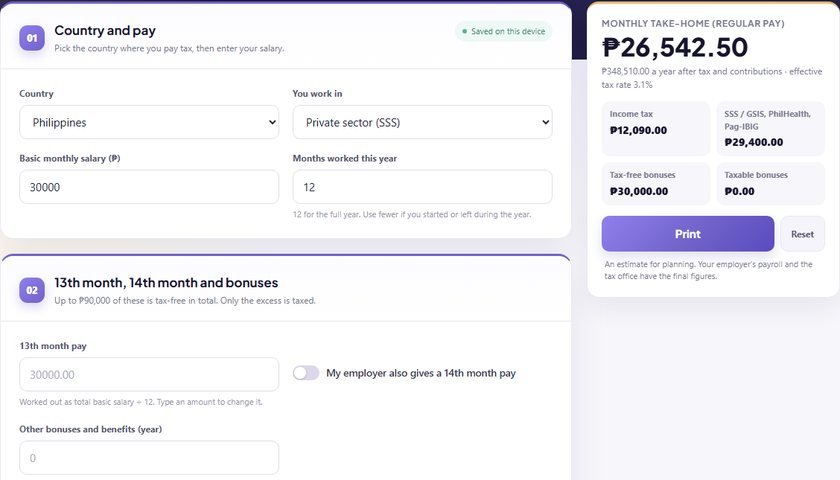
₱30,000 a month with a 14th month pay. The 13th month pay is ₱30,000 and the 14th month pay is ₱30,000, a total of ₱60,000. That is under ₱90,000, so both are tax-free.
₱50,000 a month with a 14th month pay. The two bonuses total ₱100,000. ₱90,000 is tax-free and ₱10,000 is taxable. The regular taxable pay is ₱600,000 minus SSS ₱21,000, PhilHealth ₱15,000 and Pag-IBIG ₱2,400, or ₱561,600. With the ₱10,000 excess it becomes ₱571,600, and the tax is ₱22,500 + 20% × ₱171,600 = ₱56,820 for the year. The excess bonus adds ₱2,000 of tax, which the employer usually withholds in December.
₱80,000 a month, 13th month only. The ₱80,000 13th month pay is under the ceiling, so it is tax-free. If the employer adds a ₱20,000 Christmas bonus, the total is ₱100,000 and ₱10,000 becomes taxable.
Why December pay has more tax
Employers withhold tax on regular pay every month. In the last payroll of the year they compute the tax on the whole year’s income, including any bonuses over ₱90,000, and withhold the difference. That is why a December payslip often shows more tax even though the 13th month pay itself is mostly tax-free.
Compute it
The income tax calculator works out your 13th month pay from your salary, lets you add a 14th month pay or government bonuses, applies the ₱90,000 ceiling, and shows your monthly withholding and December adjustment.